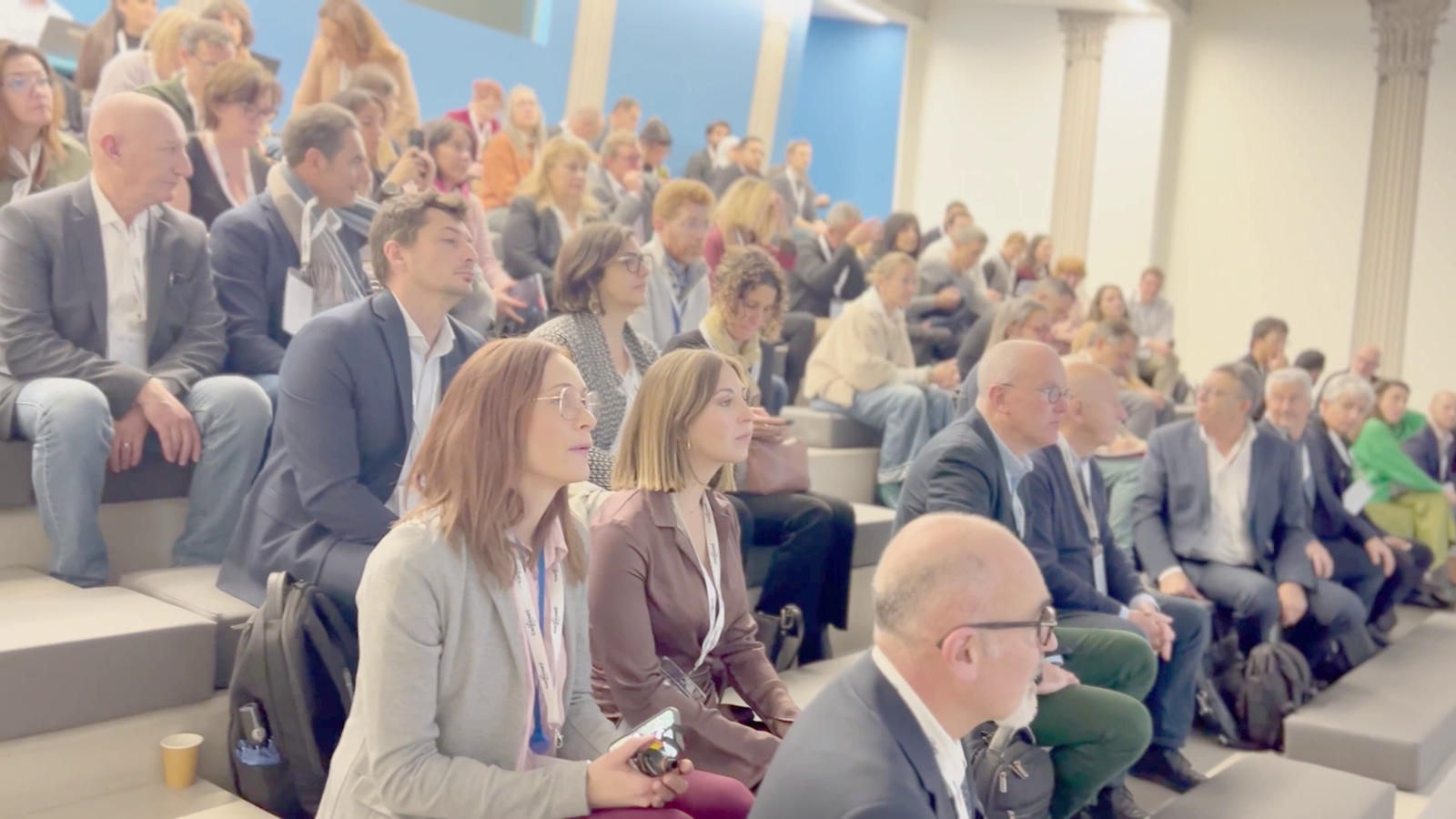
Infectious diseases remain the third leading cause of human mortality worldwide. Facing the rapid evolution of pathogens and the rise of antimicrobial resistance, « traditional methods often struggle to keep pace and there is an urgent need for innovative diagnostic solutions, » stated Prof. Pierre-Edouard Fournier, Director of IHU Méditerranée Infection, during the « Infectious Diseases Diagnostics Day: Innovation and Challenges » conference, co-organized on Thursday, December 11, 2025 in Marseille by IHU Méditerranée Infection and Eurobiomed.
This gathering aimed to assess fifteen years of innovation in infectious disease diagnostics and to open new perspectives, bringing together clinicians, researchers, and industry professionals. IHU Méditerranée Infection hospitalizes 3,000 patients annually, hosts 4 research units and operates one of the best-equipped microbiological diagnostic laboratories in Europe, while Eurobiomed, which brings together the health innovation community in southern France, plays a key role in connecting industry and clinicians and in strengthening funding applications for innovation projects, thus creating an ecosystem conducive to the innovations presented during this conference.
“Since Euromediag, which then became Eurobiomed Diagnostics, Diagnostics has always been one of the major topics of Eurobiomed” explained Emmanuel Le Bouder, Community Director at Eurobiomed. “Through this conference, we are making sure to keep on creating an ecosystem conducive to innovations.”
Between ancient technologies and molecular methods: diagnostics facing practical constraints
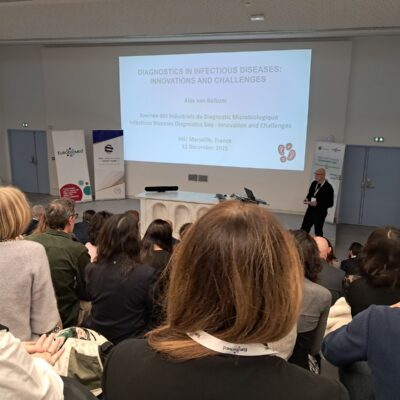 Diagnostic innovations face practical barriers that are often underestimated. Prof. Alex Van Belkum, a highly cited molecular microbiologist with extensive experience in molecular- and culture-based approaches, highlighted a surprising reality: ancient technologies such as Gram staining, developed a century ago, remain widely used in laboratories worldwide. At the same time, the lack of standardized pre-analytical routines continues to affect sample quality, compromising analysis reliability.
Nevertheless, advances are plentiful: molecular methods have dramatically reduced diagnostic turnaround times from 16 to 30 hours to as little as 4 hours. Prof. Van Belkum also opened unexpected perspectives by questioning the potential value of different human biomes, inviting the scientific community to explore new avenues beyond traditional approaches.
In fundamental research, Prof. Daniel Olive captivated the audience with his work on gamma delta cells, these atypical lymphocytes involved in cancer, tuberculosis, and viral infections, among others. His teams observed a rapid and sustained decline in these cells during SARS-CoV-2 infection, alongside increased expression of BTN3A immunoglobulins. These promising findings open new opportunities for collaboration between the Marseille Immunology Biocluster and IHU Méditerranée Infection.
From tuberculosis to zoonotic diseases: innovative players push diagnostic boundaries
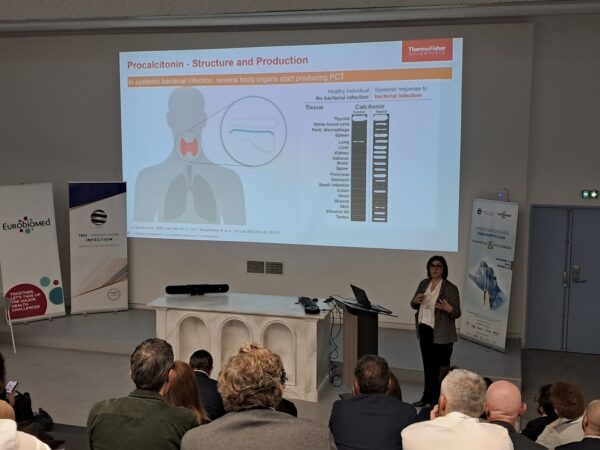 Industrial innovation was central to this conference, with striking presentations from innovative diagnostic players. Lucie Roux, R&D Project Manager at Thermo Fisher Scientific, explained how through a dual-marker strategy you can enhance clinical assessment across different infection types, helping to understand which patients to focus on for sepsis. Mathieu Marchal, sales engineer at Bruker, talked about advances in mass spectrometry for infectious disease diagnostics, including their smart strain typing solution, the IR Biotyper, focusing on fast and low running costs analysis.
Sylvain Cogne, Associate Director at Qiagen, detailed the company’s advances in tuberculosis diagnostics, this disease that remains the leading killer among single-agent infectious diseases. Qiagen now offers whole genome enrichment of tuberculosis without prior culture, a major innovation that reduces analysis times. The company has also developed a nanoplate digital PCR pre-quantification technique particularly useful for epidemiological surveillance and tracking resistant strains.
Benoit Grillet, Manager Development Scientist at Beckman, presented the company’s recent Dxl9000, a next-generation automated platform that facilitates and accelerates laboratory workflows, especially by providing rapid peak signal to support faster time to first result. Gaiané Demirdijan, Director of R&D at Beckman, called for strengthened collaboration with diagnostic stakeholders, emphasizing the importance of partnerships between industry and clinicians to develop solutions truly adapted to field needs.
Afyia Diagnostics and Innovative Diagnostics also made an impression by presenting their capacity to cover sixty zoonotic and veterinary diseases, and by leveraging this expertise for human health. Their ID Soft software facilitates result analysis and interpretation, making complex diagnostics that previously required specialized expertise accessible to more professionals.
« The two domains are not competing, they belong to the One Health framework »
The roundtable discussion led by Prof. Xavier de Lamballerie from IHU Méditerranée Infection explored the One Health approach, a concept that recognizes the fundamental interconnection between human health, animal health, and environmental health. Eric Cardinale, Scientific Director for Animal Health and Animal Welfare at ANSES, highlighted an interesting paradox: while the same technologies are used in both domains, their objectives differ radically. In human health, the emphasis is on personalized and precision medicine, while in animal health, priorities focus on herd surveillance and food chain protection. Budgetary constraints reflect this difference, with massive budgets in human medicine and severe constraints in animal health.
« Yet we can use animals as sentinels for humans. For example, Rift Valley fever starts in livestock and then reaches humans, » explained Eric Cardinale, illustrating the strategic value of veterinary surveillance for anticipating human risks. The main obstacle nonetheless remains the lack of a systematic diagnostic data chain in animal health and the need to reconcile data between the two domains. These are challenges that innovators must consider. « I meet many companies that developed tools around Covid and want to move into the animal world, » recounted Gilles Nespoulos, Corporate Marketing Manager Diagnostic Group at CEVA. « This is probably the wrong way to do things: you shouldn’t start with the technology but with the service provided to users, who are very different here. »
« In Europe, if you use an AI tool, you are responsible for what it does »
Artificial intelligence closed this day rich in perspectives. « If you work with data, quantity and quality must be balanced, » reminded Prof. Van Belkum, emphasizing the need to build comprehensive biological databases while respecting confidentiality and legal aspects. « Maintain a critical attitude toward AI, think about what you really need, » he advised, urging against following trends.
Dr. Jacques Bou Khalil from IHU Méditerranée Infection presented a concrete application of deep learning: bacterial classification from scanning electron microscopy images. « Emerging models enable faster and more precise segmentation, classification and feature detection, » he explained, announcing that the next steps for tabletop electron microscopy will include machine learning and automation.
Vincent Nault, VP Global health data insight at bioMérieux, addressed clinical decision support systems for antibiotic therapy, a crucial domain since 40% of hospitalized patients receive antibiotics on average. But he issued an unequivocal warning regarding AI use in this field: « Specifically for antimicrobial management, supervision is non-negotiable, as AI can amplify poor decisions. Yet in Europe, if you use an AI tool, you are responsible for what it does. » The user’s legal responsibility strictly frames the deployment of these tools.
Prof. Van Belkum sees the most immediate AI application « when the patient faces the general practitioner: with a complete and quality set of questions to ask, you can, with AI assistance, get a good idea of what is happening. » A vision that positions artificial intelligence not as a substitute for medical judgment, but as a tool to support more informed and shared clinical decision-making.
Check too this video overview thanks to IHU Méditerranée Infection